

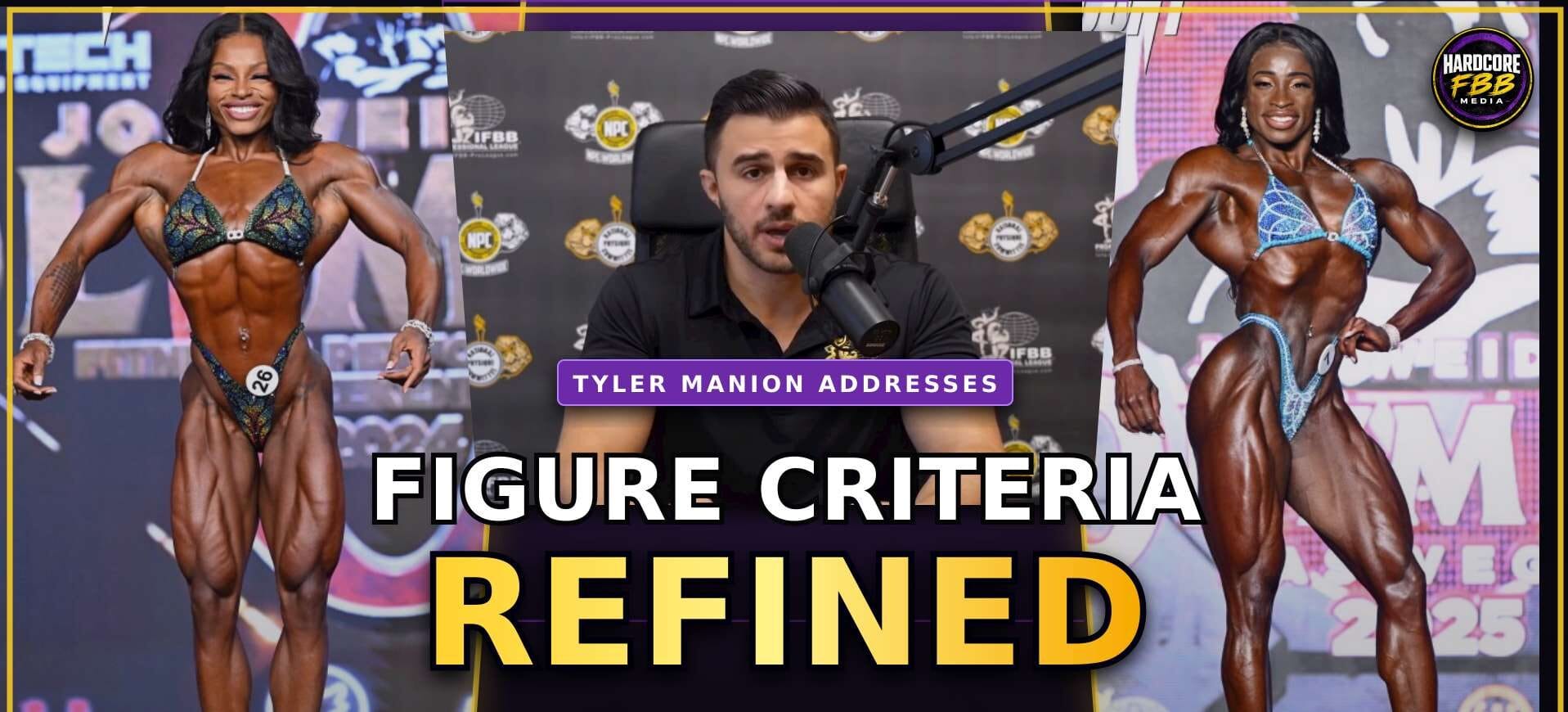
IFBB Pro League Vice President Tyler Manion has issued an important clarification regarding the judging direction of the Figure division, warning that athletes who display excessive muscularity, extreme conditioning, or both, will face stricter penalties moving forward.
In a video addressed to professional and amateur competitors, Manion explained that some Figure athletes have returned to the stage this season with improved physiques but have added more muscle and reached a level of conditioning that no longer reflects the intended standard of the division.
The message is clear: Figure should reward shape, balance, proportion and controlled muscular development, not the size and extreme conditioning associated with Women’s Physique.
Rhea Gayle and Cydney Gillon identified as the Figure standard
Manion referenced reigning Figure Olympia champion Rhea Gayle and eight-time champion Cydney Gillon as leading examples of the look the IFBB Pro League wants to preserve.
Using Gayle’s Olympia-winning physique as a current benchmark, Manion highlighted her balance between the upper and lower body, pronounced V-taper and appropriate muscular development through the shoulders, arms and legs.
Despite displaying visible back detail and separation, no individual area overpowers the rest of her physique. Her overall presentation maintains the symmetry, flow and femininity expected in Figure.
The objective is not to eliminate muscularity from the division. Figure athletes are still expected to demonstrate developed shoulders, a wide back, a small waist, balanced legs and clear muscular detail. However, that development must remain proportionate and should not begin to resemble a Women’s Physique package.
Figure conditioning should remain below Women’s Physique
Conditioning was another major focus of Manion’s announcement.
According to the updated direction, Figure competitors should display visible muscular separation, but that separation should remain relatively slight. Deeply etched lines, extreme hardness and the level of dryness commonly rewarded in Women’s Physique are not considered appropriate for Figure.
Manion described the desired Figure conditioning as slightly harder than the standard displayed by the leading Wellness Olympia competitors, while remaining clearly separated from Women’s Physique.
This distinction is essential to maintaining the identity of each women’s division. A Figure athlete can therefore arrive onstage in exceptional condition and still be marked down if that condition exceeds the intended standard.
Stricter penalties will be applied
The most significant part of the announcement concerns how the criteria will be enforced.
Manion stated that athletes who appear noticeably more muscular or more conditioned than competitors representing the desired standard will be penalized more heavily than they may have been in the past.
An athlete could possess what appears to be one of the most impressive physiques onstage but still lose placings because the package is unsuitable for Figure.
Competitors presenting either excessive muscularity or excessive conditioning will be marked down. Athletes displaying both are likely to receive an even more substantial penalty.
This direction will be particularly important at the upcoming Olympia, where the world’s leading Figure competitors will be assessed against the division’s intended standard.
The message also applies to amateur competitors
Although the Olympia will provide the most visible test of this judging direction, Manion stressed that the announcement is not limited to established professionals.
Amateur athletes, coaches and posing teams are also expected to take notice. The criteria should influence long-term decisions concerning off-season development, contest preparation and the level of conditioning athletes attempt to achieve before stepping onstage.
For competitors who have already reached the appropriate level of muscularity for Figure, continuing to add size may be counterproductive. Improvements should instead focus on proportion, symmetry, presentation and refining weaker areas without pushing the entire physique beyond the division’s boundaries.
Heights and weights will be recorded at the Olympia
The IFBB Pro League will also record the heights and weights of Figure competitors at the Olympia for data-gathering purposes.
Manion explained that height-and-weight systems have worked well in divisions such as Classic Physique and Men’s Physique. The organization will now examine the information collected from Olympia-level Figure competitors to determine whether a similar structure may be useful in the future.
However, no official height-and-weight limits for Figure have been announced at this stage. The Olympia measurements are a test and data-collection exercise rather than confirmation that restrictions will be introduced.
The results will help the organization decide whether formal regulations should be considered for the following season.
Protecting the identity of the Figure division
Manion acknowledged that judging becomes particularly difficult when several of the best physiques in a lineup are also too muscular, too conditioned or both.
The purpose of the stricter direction is to “dial back” the division and ensure that the winning athletes represent what Figure is intended to be.
This announcement does not suggest that Figure will become less athletic or less muscular. Instead, it reinforces the importance of controlled development, balanced proportions, a strong V-taper and visible, but not extreme conditioning.
The upcoming Olympia is expected to be a crucial reference point for competitors and coaches. If the updated direction is enforced as firmly as announced, bringing the biggest or hardest physique to the stage will no longer be viewed as an automatic advantage.
The winning Figure package must not simply be impressive. It must also remain unmistakably Figure.